A Fascinating Article About Lichens That Would Have Benefited From My Editing

Before I tell you about that very interesting article about lichens from The Atlantic and what I would have done to improve it, I first want to acknowledge that everything I write or edit could also benefit from someone else's editing and/or copy-editing.

At my previous full-time-with-benefits gig, pre–Huge Hound, my main job was overseeing a group of copy editors, but I also edited (as opposed to copy-edited) pieces by wine and spirits expert Elin McCoy. Whenever I'd route my edit of one of Elin's stories to a copy-editing colleague for her/his review, I always hoped it would come back with nothing corrected or questioned, but, of course, there were always at least a couple things that needed improving or fixing. Producing stories that are worth reading takes a lot of effort, and the more brains and pairs of eyes that are being utilized, the better the stories usually are.

I clicked on "How a Guy From a Montana Trailer Park Overturned 150 Years of Biology" because it was one of the suggested stories at the bottom of Christopher Orr's review of Rogue One: A Star Wars Story. Tony and I had watched that movie on Netflix Saturday night, and I went in search of reviews on Rotten Tomatoes on Sunday morning. I agreed with a good deal of what MTV's Amy Nicholson wrote in this review, which took the movie to task for emphasizing fan service at the expense of new ideas.

By the way, I didn't see any of the original-trilogy movies in theaters. My parents didn't make it a habit to take my older sister and me to science-fiction movies because sci-fi wasn't their bag, though I do remember catching E.T. in the theater with my mother when I was in 8th grade. If I remember correctly, I actually saw The Empire Strikes Back before I saw Star Wars, at my Aunt Lorene's house in Bridgeton on a Sunday evening. Unlike the Hawleys, my aunt sprang for HBO. I also saw only the first film in the second trilogy because I thought The Phantom Menace was so poorly directed. I couldn't get over how awful such usually terrific actors as Natalie Portman and Ewan McGregor came across in that movie, and I had to conclude it was George Lucas's fault.

Now back to our lichen story:

  • He was raised in a Montana trailer park, and home-schooled by what he now describes as a “fundamentalist cult.” At a young age, he fell in love with science, but had no way of feeding that love.

I see no need for a comma after either "park" or "science." There's no change in subject and no obvious reason to pause there. *shrugs*

  • His missing qualifications were still a problem, but one that the University of Gottingen decided to overlook.

There's a bit of a pause after "problem," so I can kinda sorta see a comma there, but I probably wouldn't have bothered with one. That's the end of my comma quibbles. And I swear all of the remaining points I'm going to bring up will be more interesting. 😄

  • You’ve seen lichens before, but unlike Spribille, you may have ignored them. They grow on logs, cling to bark, smother stones. At first glance, they look messy and undeserving of attention. On closer inspection, they are astonishingly beautiful. They can look like flecks of peeling paint, or coralline branches, or dustings of powder, or lettuce-like fronds, or wriggling worms, or cups that a pixie might drink from. They’re also extremely tough. They grow in the most inhospitable parts of the planet, where no plant or animal can survive.

That paragraph is a beautiful, imaginative collection of sentences, so kudos to the writer, Ed Yong, and his editor(s). And extra props for using the new-to-me word coralline.

The first time I read this passage, I didn't have a problem with the multiple ors, but they bother me more now, on closer inspection. And I take exception to the last two sentences because: 1) I think of lichens, not inaccurately, as fragile organisms that are susceptible to air pollution, so I believe the "extremely tough" description needs to be qualified. And 2) I'm really curious to learn what's meant by these inhospitable places "where no plant or animal can survive." I immediately thought of lichens' ability to grow on bare rocks, but that's not a "part of the planet." I next thought of the Arctic tundra. Although it's not terribly hospitable, with a growing season of two months or less, some plants and animals do live there. A couple concrete examples of these harsh parts of the globe would be helpful.

  • The backlash only collapsed when Schwendener and others, with good microscopes and careful hands, managed to tease the two partners apart.

I prefer "collapsed only when" to "only collapsed when," and I would have made that change if I'd been the editor or copy editor. The altered wording recognizes the more-correct placement of the adverb only—modifying when rather than collapsed—and it still reads fine. Sometimes moving an only (or a just) to its more-correct location causes a sentence to seem stilted and not like how people really talk/write. For instance, I wouldn't change "I'm only going to tell you this once" to "I'm going to tell you this only once," even though the latter is really what's meant. The former sentence is basically an idiom, and I've got better things to do with my time than fight for the second sentence's superiority.

  • Schwendener wrongly thought that the fungus had “enslaved” the alga, but others showed that the two cooperate.

My previous employer discouraged its writers and editors from using the word but. I use but regularly in my own writing, but I take issue with its inclusion in the sentence above. The wrongly already told us the idea of the fungus enslaving the alga is inaccurate, so the supposedly alternative (as signaled by the but) idea that follows (it's really a cooperative arrangement) in no way contradicts the first part of the sentence. I would either 1) delete wrongly or 2) put a semicolon after alga and lose the but.

  • Two Germans, Albert Frank and Anton de Bary, provided the perfect one—symbiosis, from the Greek for ‘together’ and ‘living’.

Why is it so important to note that those two dudes were German, so much so that it's the only characteristic used to describe them? And why is that stubby description more important (based on its placement first in the sentence) than these distinguished scientists' names? I would have started the sentence "Albert Frank and Anton de Bary, two German scientists who studied both plants and fungi, provided... ," and I would have turned the single quote marks into double quote marks and put the final double quote mark after the period, where it belongs. Actually, scratch that part about the quote marks. I would have put together and living in italics, as I've been doing throughout this post when I've used words as words. My go-to example of using a word as a word—that also uses a letter as a letter—is "Banana has three a's."

  • When we think about the microbes that influence the health of humans and other animals, the algae that provide coral reefs with energy, the mitochondria that power our cells, the gut bacteria that allow cows to digest their food, or the probiotic products that line supermarket shelves—all of that can be traced to the birth of the symbiosis as a concept.

The the before symbiosis isn't wanted.

  • Whenever they artificially united the fungus and the alga, the two partners would never fully recreate their natural structures.

I'm a fan of hyphenating the word that means to create again to distinguish it from the word we associate with exercise or playing a game out on the blacktop behind the elementary school after lunch.

  • He has shown that largest and most species-rich group of lichens are not alliances between two organisms, as every scientist since Schwendener has claimed.

A the is needed before largest. And I would have made it "has shown that the lichens in the largest and most species-rich group are... ." Otherwise it definitely reads like subject-verb disagreement to me, with the group calling for an is, not an are.

  • To find out, Spribille analyzed which genes the two lichens were activating. ... But when Spribille removed all the basidiomycete genes from his data, everything that related to the presence of vulpinic acid also disappeared.

How does one determine which genes the lichens were activating? And what does the writer mean by activating? And how does our friendly scientist remove genes from his data? I don't follow. Maybe you do.

  • Throughout his career, Spribille had collected some 45,000 samples of lichens.

Holy shit! That's a lot of lichens.

  • Unless you know what you’re looking for, there’s no reason why you’d think there are two fungi there, rather than one—which is why no one realised for 150 years.

Where did that British spelling of realized materialize from? The American spelling is used six paragraphs earlier.

  •  Lichens are alluring targets for ‘bioprospectors’, who scour nature for substances that might be medically useful to us. And new basidiomycetes are part of an entirely new group, separated from their closest known relatives by 200 million years ago.

There's another unwanted set of single quotes. And the last sentence should have either the by or the ago, not both. My assumption is that "an entirely new group that separated from its closest known relatives 200 million years ago" is the way to go, but I would have conferred with the writer before making that change.

  • That’s a theme that resonates throughout the history of symbiosis research—it takes an alliance of researchers to uncover nature’s most intimate partnerships.

And my last nitpick: I would replace the em dash with a colon because this is a textbook example of what a colon is used for: indicating an explanation or an expansion of what precedes that punctuation mark. And since it appears the style of this publication is to not capitalize the first letter in the first word of a complete sentence that follows a colon, I would retain the lowercase i in it.

Chocolate-Mint Vegan Frozen Dessert

The other day, I made my first frozen dessert in South Florida: a vegan one that incorporated the essence of fresh mint ...

... from our apartment complex's community herb garden:

The mint, of unknown variety or varieties, completely fills the middle bed. Several other types of herbs, including rosemary, dill, parsley, and basil, reside in the other beds.

When my husband, Tony, and I lived in Hunterdon County, New Jersey—for about a year and eight months, after having left Manhattan in August 2015—I started up a company called Huge Hound Frozen Desserts LLC. (The website, which I put together myself, is here.) By that time, I'd been whipping up dairy ice creams for more than 15 years, first using the kind of ice cream maker that utilizes a chemical-filled metal canister you have to store in the freezer and then using the more-advanced, self-contained kind that needs only to be plugged in.

My friend Dan once referred to me as an "ice cream maven." I'm using a variation of that description above in the tag line for this website.

I began making dairy-free FDs after I met Tony, because he can't eat milk or cream (or gluten or legumes). The first year we dated, I focused on sorbets. My favorite was Concord grape, but I also remember making (two) very good ones from mint and watermelon. Later, I whipped up some delicious FDs using coconut milk as the base, including one flavored with lime basil.1 (Like I wrote in my first post and will no doubt write in many more posts here, if you want the password to my other, long-running, personal blog, which would allow you to read the two linked posts above, just shoot me an email at bill@billhawley.net.)

I've never been the hugest fan of coconut (though I'm not a hater), and I didn't necessarily want that flavor mixed in with the chocolate or lemon verbena or whatever I intended to be my primary flavoring ingredient(s), so when I started Huge Hound, one of my main goals was to create a vegan-frozen-dessert base that was as neutral tasting as possible.

And I did it. My ingredients were hemp and flax milks; refined coconut oil, which had had its coconut flavor removed during processing; agave syrup; and small amounts of lecithin, xanthan gum, and arrowroot, which thickened and emulsified the fatty-and-sweet mixture. Plus a pinch of salt. On principle, I would have preferred to avoid using the much-trifled-with RCO, but I found I really needed the boost of fat it provided; the nondairy milks on their own weren't rich enough to produce a creamy-textured product.

After I'd been selling my VFDs and ice creams for a while, I began thinking about ways to cut costs, so the last time I made a Huge Hound VFD, which was flavored with chocolate and ginger, I used only flax milk, because hemp milk is significantly more expensive. Hemp milk is also more strongly flavored than flax milk, so eliminating it as an ingredient improved the neutrality of my base.

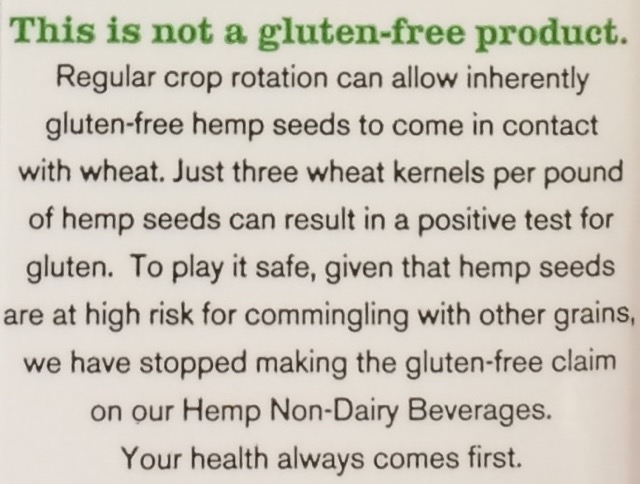
I was somewhat sorry to ditch the hemp milk, though, because I think hemp is an amazing plant that we should be using in many different ways, including in foods, paper, and plastics. But I just learned when I was buying my ingredients to make my Chocolate-Mint VFD that I have another good reason for giving it up: One of the two major makers of hemp milks, Pacific Foods, is now putting a warning on its labels telling its customers that its hemp-based nondairy beverages shouldn't be considered gluten-free:

I had been using Living Harvest's Tempt-brand hemp milk for my Huge Hound VFDs, and its packaging contains no such warning. Maybe Living Harvest is confident in its ability to prevent cross-contamination with wheat, but I didn't want to take that chance, so when I made this latest VFD a couple weeks ago, I again used only flax milk.

I applaud Pacific Foods for erring on the side of caution at the risk of losing customers. People like Tony who have serious dietary issues need and appreciate candor from manufacturers and restaurants so they can make informed decisions.

Once at the Union Square outpost of Whole Foods, a woman standing near me complained that the package of dried fruit she was holding was labeled as being gluten-free. "How stupid do they think we are?" she asked. I just wanted to get in and out of the store and wasn't really in the mood for a teachable moment, so I didn't explain to her that manufactured foods can be contaminated with things like tree nuts, peanuts, dairy, and gluten based on how they're processed, not only by the ingredients they obviously contain.

A case in point: Tony and I just got back from our local supermarket, and we had to go with the third brand of walnuts we picked up because the first two said they could contain traces of gluten. (He's making Chicken With Walnut Sauce for dinner tonight.)

The other day, at the same store, I put a bag of pine nuts back on its hook because the packaging said the PNs were "produced on shared equipment with peanuts, tree nuts, milk, wheat, soy & egg." The only things missing from the list of the big eight food allergens were fish and shellfish.

OK, let me reel myself back in *sound of fishing line being respooled* and post a photo of my finished VFD:

Our dinner guests three nights later—Tony's longtime friend Marchéta and her wife, Uli, who live in the next county north of here—went back for seconds or thirds. I hadn't lost my touch. 

1In that same linked post, you can see I still made dairy ice creams for my own enjoyment, including the Gooseberry With Gooseberry Swirl that was one of my favorites of all time. And I kept experimenting with sorbets, culminating in the Chocolate-Blackberry that may be my favorite FD ever.

An UPDATE the next day:

That's the out-of-this-world dinner Tony made last night, with the chicken-and-walnut stew served over GF pasta with additional, chopped walnuts. The herb on top is cilantro—from the grocery store, because there's none growing in the community garden.

An UPDATE two days later: My friend Desirée sent me a link to this New York Times story about vegan frozen desserts, which has a sidebar on a VFD base that uses hemp (or cashew) milk, coconut cream or milk, and agave (or corn) syrup.

Introducing a New Blog With a Discussion of Dashes

I'm starting this new blog so I have an outward-facing space to highlight my writing, editing, and frozen dessert–making skills.

Since September 2005, I've been regularly writing Hawleyblog, which, depending on the individual post, has maybe been about food, current events, theater, music, and/or other topics that interest me but has also always been a diary of the events in my life. And I've enjoyed having that record to look back on. For instance, if I want to relive the time I took my then-13-year-old identical-twin nephews to the New York Hall of Science museum in Queens, I can reread one of my favorite Hawleyblog posts, from December 2011. (And you can read it, too, if you request the password I've recently protected that blog behind. Just send an email to bill@billhawley.net.) 

That's me pretending to pet a (much-magnified) water flea at the Hall of Science.

That's me pretending to pet a (much-magnified) water flea at the Hall of Science.

The main purpose of this new blog is, frankly, to sell myself to potential employers and clients. I'll use it to demonstrate I can write and self-edit and to tout some of my accomplishments as a copy editor, line editor, and small-business owner. And I'll no doubt also run the occasional photo of my cute dog and my cuter husband.

I also plan to discuss matters of English-language grammar, diction, and punctuation. And now *cracks knuckles* I'm going to write about how I like to use the hyphen's longer and less-well-known punctuation-mark friends: the en dash and the em dash.

I used an en dash in the first sentence of this post, in a compound, attributive adjective in which one of the components of the compound ("frozen dessert") consisted of two words. Some editors would prefer two hyphens ("frozen-dessert-making") to the en dash, and I don't necessarily think that's wrong. It's just not my preferred punctuation method.

Just about everyone agrees on using an en dash rather than multiple hyphens when a proper noun is involved. "National Book Award–winning author" looks so much better than "National-Book-Award-winning author"; the former construction respects the integrity of the multiword proper noun.

As for em dashes, I prefer using them to set off a fragment of a sentence that reads like an important but ultimately omittable1 aside. Here's an example from the November 2009 issue—the final issue2—of Gourmet magazine that also features a classic, proper noun–incorporating en dash:

  • Our Pennsylvania Dutch–inspired Thanksgiving menu brings together all those things—savory and sweet, new and nostalgic—that make any Thanksgiving an occasion to remember. (p. 24)

(By the way, I would have deleted the first Thanksgiving in that sentence.)

I don't like using em dashes in a situation where a semicolon is the obvious choice. At my last full-time-with-benefits job, as a senior editor who oversaw a team of copy editors at a business-and-finance magazine, I coined the term em-dash fault3 for the joining of two complete sentences by an em dash. Here are two examples from copy that was routed to us back in the day:

  • It comes apart easily no matter how cold the metal gets—even a novice won't spill a drop.

  • "I think there's still a measure of skepticism that exists toward Wall Street—that's not going to change."

In both cases, we replaced the em dash with a semicolon, whose main job is to separate two sentences that are deemed worthy of a closer connection than a period provides.

And the other night, in my bedside reading, The Queen of the Night, by Alexander Chee,4 I came across these two examples of an em-dash fault in rapid succession:

  • All that would be required was for her to find something I'd forgotten about, some incontrovertible proof—much as I knew her kind, I was sure she knew mine. (p. 305)

  • Each day I was to begin at the piano, and to begin with my posture at the piano—I was to sit erect, head slightly lifted. (p. 315)

In between, I found this dash-filled mess of a sentence:

  • He was quite small in stature by comparison to Turgenev, who kissed him on both cheeks—Louis looked a bit like an old fox in evening dress, his whiskers and sharp eyes quizzical as he took me in—all of his weight was in his eyes, his gaze—all of his body raised up so he might see. (p. 311)

If I'd been this novel's copy editor—and I wish I had been, because it seems like it would have been a great project to have been involved with—I would have put periods after cheeks and took me in. And I would have worded and punctuated the last part this way: "All of his weight was in his eyes, his gaze. And all of his body raised up so he might see."

Though it might be seen as inconsistent, I take no issue with a complete sentence being plunked down in the middle of another complete sentence and being set off by em dashes. Here's an example of what I mean from that same Gourmet magazine:

  • Here are six sweet, seasonal breaks from the norm—fig crostata, anyone?—engineered to add a little variety to your dessert offerings. (p. 42)

I could also easily see those three words inside parentheses, another fine option when you're inserting a sentence inside another one.

Thanks for reading this first post of mine.

1Some believe the old-school omissible is preferable to omittable.

2I'm reading that old magazine now because I had stowed it away, still sealed in its plastic bag, back then, because I thought it would be fun to treat it like a mint-condition comic book. I opened it up to start reading it just prior to our move to Florida, when I was going through a lot of old crap I wished I'd recycled or thrown out years ago.

3The only reference to an em-dash fault I found online when I searched just now was on the last page of this pdf that includes the postscript and a list of corrections for a book called Bad Medicine. I'm curious to know whether the person who compiled this list has the same definition for an em-dash fault as I do.

4I got a little carried away with footnotes in this post, but it gave me some practice at creating superscripts in Squarespace's markdown mode. I finished The Queen of the Night last night. It was a great read, with oodles of period details and a captivating main character.