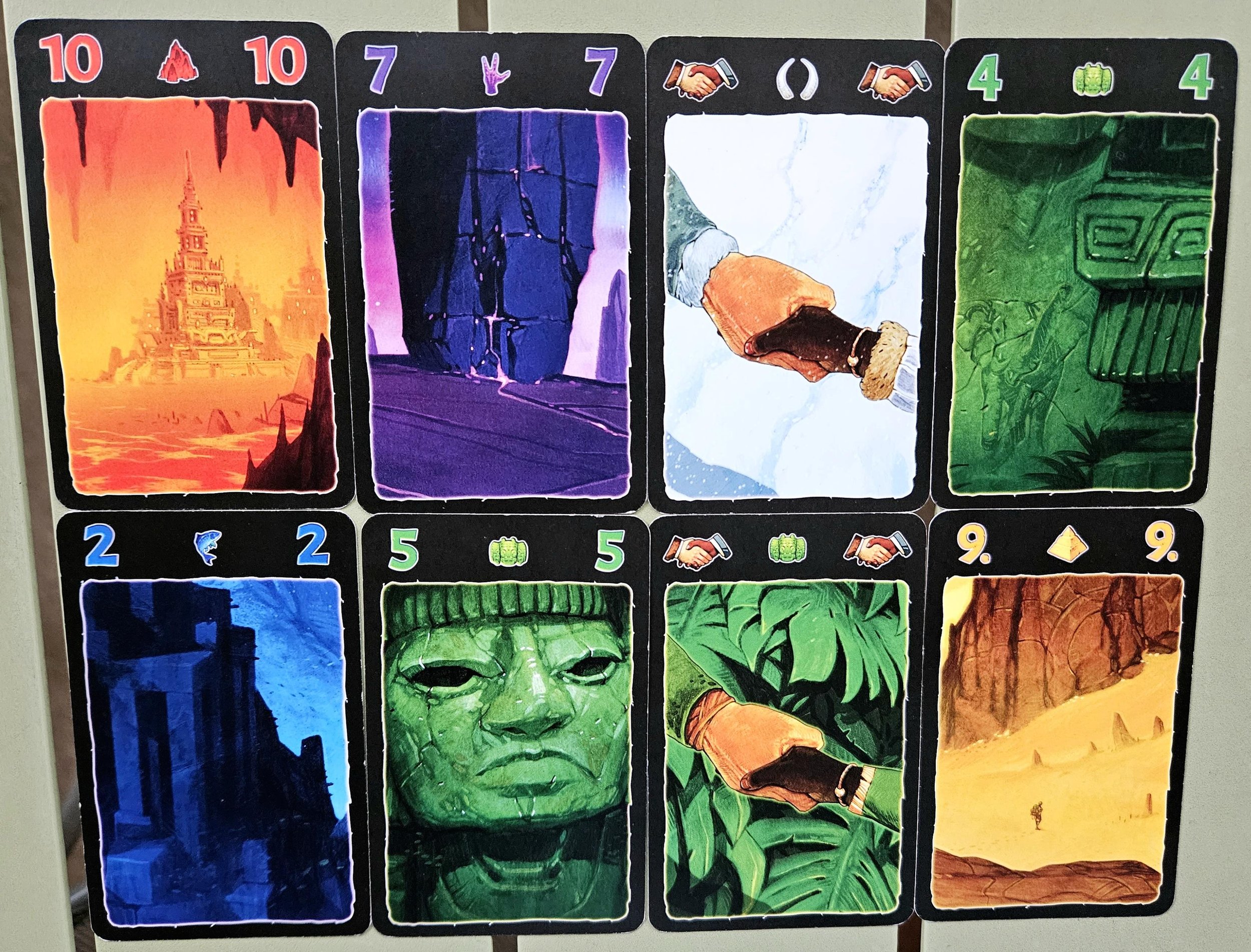
It’s not uncommon to get in your initial hand of cards, say, two wager cards for an expedition and no other cards at all in that expedition’s color. If you’ve got a lot of high cards for other expeditions, which you will want to play later in the game, and no other wager cards, you feel like you don’t have much of a choice but to gamble on that expedition. In that situation, your daring move is just an act of desperation.
The big point I’ve left out so far is that it costs you 20 points to fund your expedition, so if you manage to place cards valued at only 14, for example, before the game ends, you’ll lose 6 points on that expedition. If you had started out with two wager cards, you’ll lose 18 points, because losses are also doubled, tripled, or quadrupled.
Each player is dealt eight cards at the beginning of a game, and that’s the number you will always have in your hand at the end of a turn. Every turn, you must play a card on your growing lines of expeditions or into the discard piles of different colors that sit between the two players. You then take a card from the top of the deck or from the top of a discard pile. (You can’t discard a card and then immediately pick it up.) I’m certain the number of cards was also tested extensively, and eight must have been the right number for making decision-making neither too easy nor maddeningly hard.
Speaking of eights, if your row of cards for a given expedition (color) is eight cards or longer at the end of the game, you get 20 bonus points. The bonus points are not multiplied if you’ve played any wager cards.
You’re supposed to play three consecutive games to determine the overall winner, but sometimes Tony and I stretch it out to four, if the person in the lead at the end of three games is willing to do so. A game is over when the last card in the deck is drawn; it can’t be played, which lends an air of anticlimax to the final turn.
I started out more cautious, usually initiating only three expeditions per game, but I’ve learned from Tony that the winner is often the boldest player. I’m more likely to discard cards that could eventually come in handy for me, hoping I can scoop them back later if I need to, but almost inevitably, Tony will grab them before I can. I’m also more likely to discard a card I know or strongly suspect Tony can use, but never something so helpful as a 7, 8, 9, or 10. Tony hangs on to cards that would be helpful to me like he’s trying to turn them into diamonds. Ha!
He’s right to do that because foiling your opponent is the only way to consistently win at this game. During a game this past Sunday, I discarded some purple cards that helped Tony get a row of eight, cementing his victory.
I decided to buy Lost Cities after watching this video from British game enthusiast Actualol in which he names his top 10 games for couples and this video from Homestead, Florida–based board game site The Dice Tower of Mike DiLisio, Zee Garcia, and Tom Vasel listing their top 10 casual, two-player games. Lost Cities was Actualol and DeLisio’s #1 game and Garcia’s #2 game.